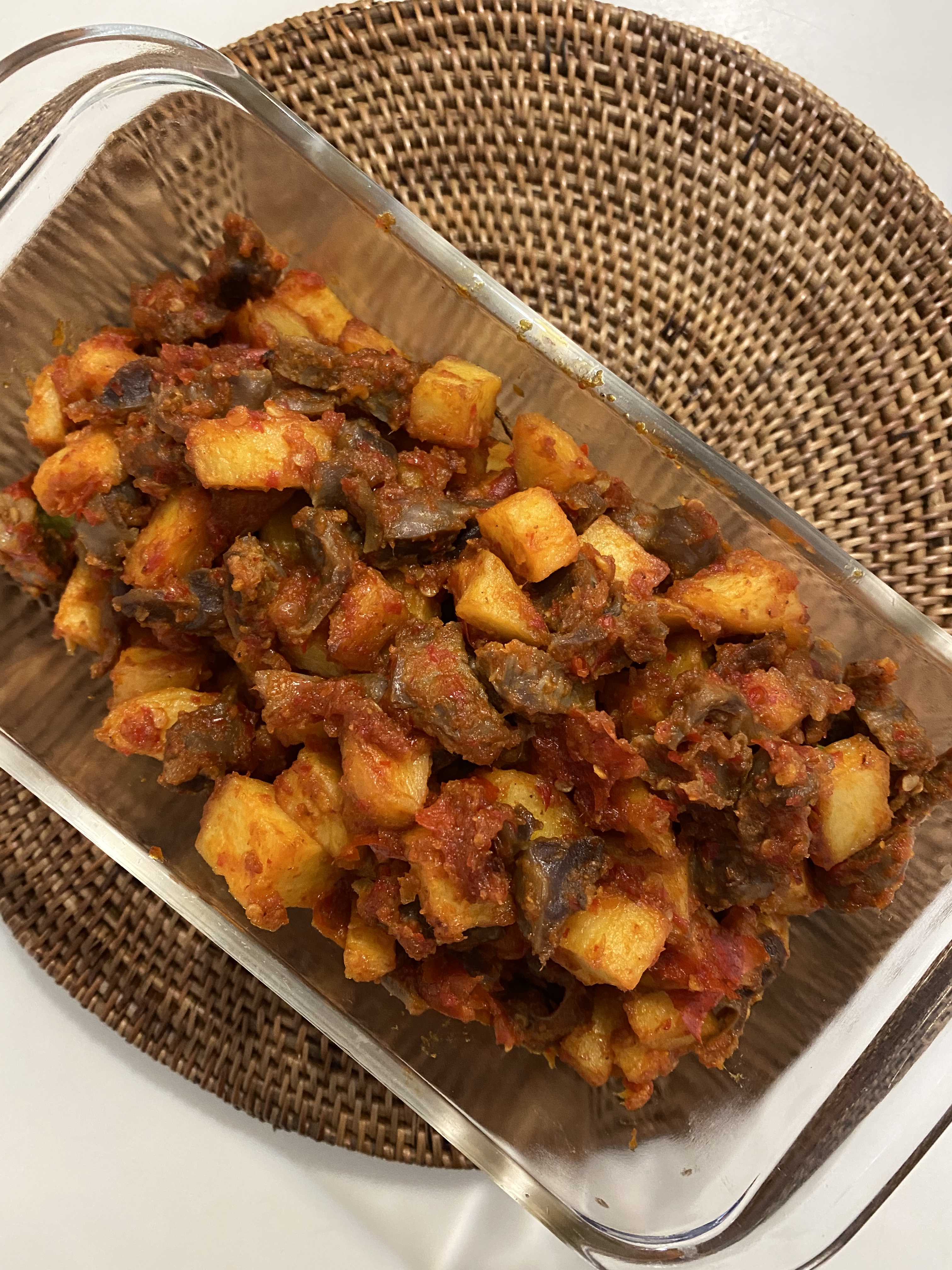
Ooookay, I’m not super sure the English term for it, but it’s basically another Indonesian take at sambal (if we could put sambal on everything, we would—wait.) Kentang is potato, sambal is, well, sambal (chili paste — mixed with garlics, shallots, salt, sugar, pepper, and sometimes, shrimp paste,) and goreng means fried.
This dish is not exclusively for Eid, and many households cook it as side dish (yes, it has potatoes AND we eat it with rice) and one of folks’ favorites because you can keep it and re-heat it for the next meal.
Potato is the main ingredients, and folks add another protein on it: quail eggs, chicken livers and gizzards, and (sometimes, if you — and your nose — are strong enough,) stinky beans.
A bit of warning, this dish has lots of chilis and shrimp paste. This is not for the faint of heart.
Sambal Goreng Kentang
With chicken gizzards because that’s how I like it
For 4-5 people; and you can keep it for 2-3 days in a fridge
Cut and diced: 800 grams potatoes (you can round it up to 1 kg. This depends on how much you like this dish, though.) 300 grams chicken gizzards
Spices, blended: 10-15 pieces red chilis (I don’t know its exact English name, but in Indonesia, we call it “cabe keriting” (curly chilies.) In Malaysia, though, I’m using Johor chili) 5 pieces bird-eye chilis (if you like it really, really spicy) 6 garlics 10 shallots 1/2 to 1 teaspoon of shrimp paste (belacan/terasi) (heat the shrimp paste first to exude its aroma) 2 candlenuts 1/4 teaspoon of turmeric powder (optional)
Spices, mashed/tear: 3 kaffir lime leaves 3 bay leaves 2 cm ginger 2 cm galangal
To taste: Salt Sugar Pepper
Cooking oil
Deep fried the potatoes and the gizzards separately. Set aside.
Put a bit of oil on the wok (you don’t have to use new oil; you can use the oil from previous fry (potatoes and gizzards) and heat the blended spices. Add the mashed spices/herbs. Heat it until it’s fragrant.
Put potatoes and gizzards into the wok and mix it thoroughly. In Malaysia, we had this term: Pecah minyak; in Indonesia, my aunt mentioned to me to cook it “until dry” — meaning that you need to mix it on the hot wok until the sambal sticks on the potatoes and gizzards and you could see the oil “separated” from the dish. You shouldn’t see some kind of “chili soup” on the wok. The sambal needs to look like marinated the potatoes and the gizzards. And yes, it needs upper arm workout to handle this dish.
Hi all! Eid Mubarak! May all of us are having blessed Eid except some of you who refuse to wear masks and keep violating the self-quarantine rules.
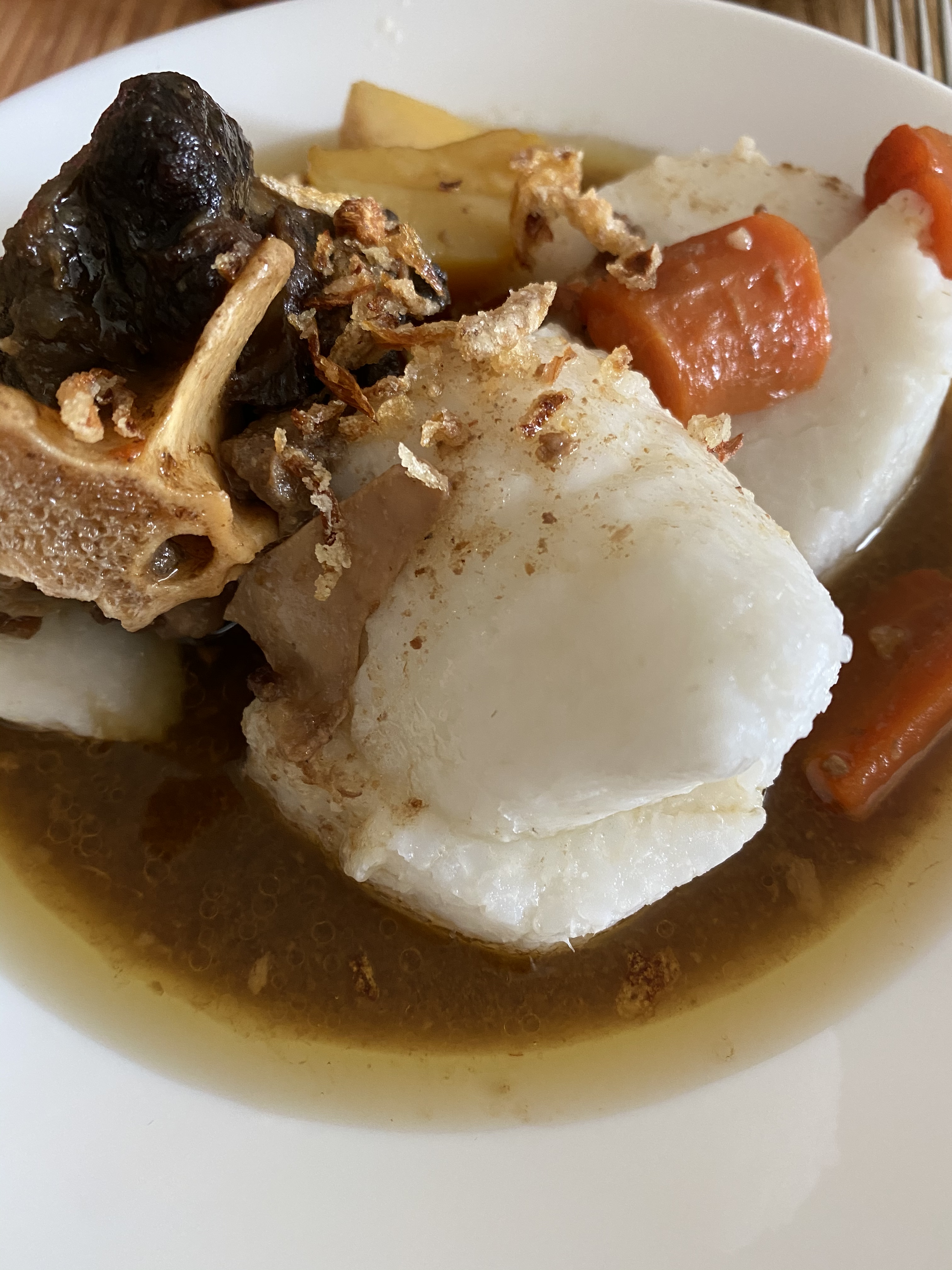
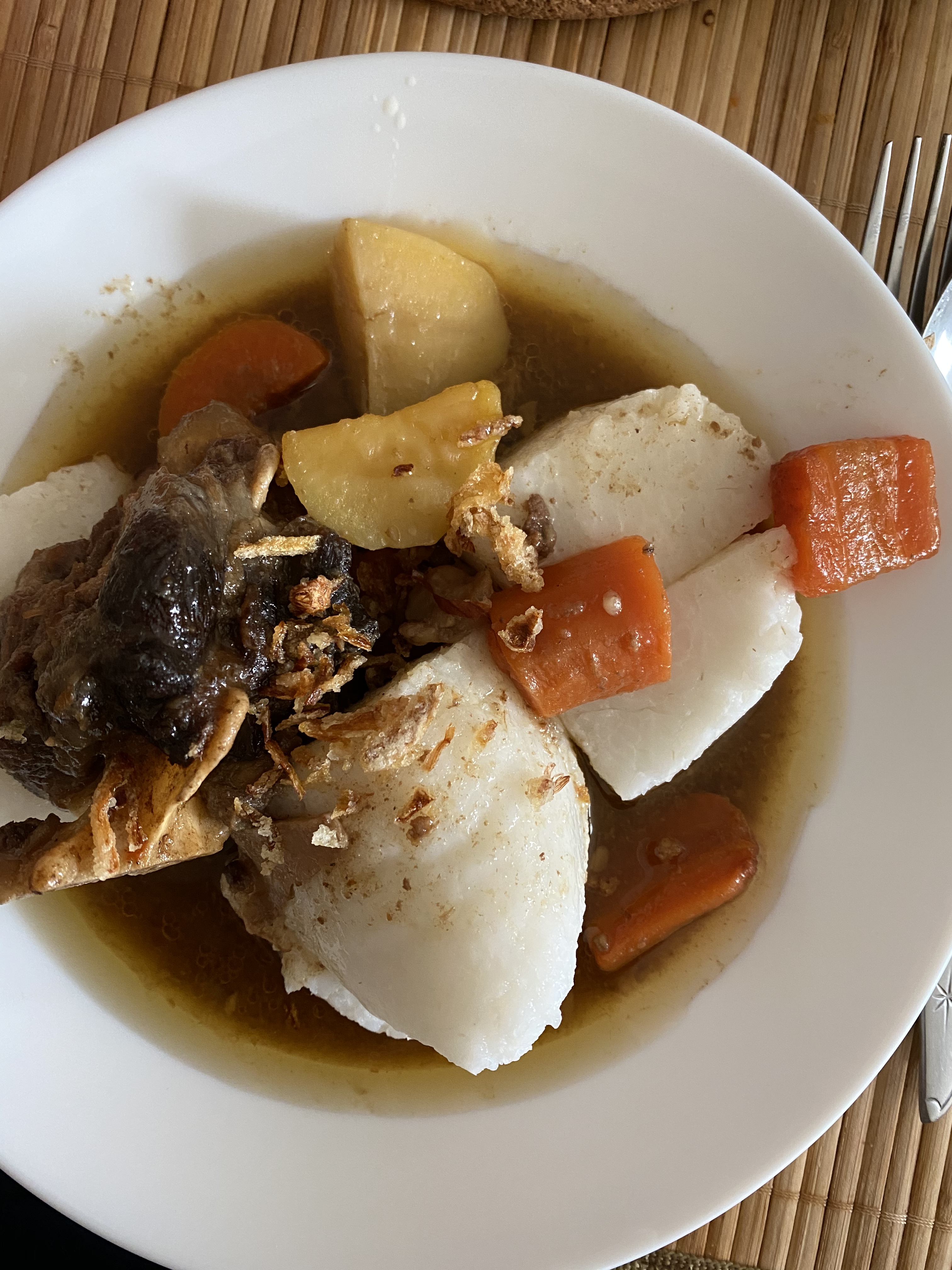
Anyway, we talked about opor ayam yesterday. For lunch, I had ketupat with oxtail soup. Oxtail itself is not a stranger for many culinary delicacies. Italian knows coda alla vaccinara — a really warm, fulfilling, and yummy oxtail with tomato and parsley-based braise. In Malaysia, the popular term is “sup ekor” (“ekor” means tail) — and you can guarantee many Malaysians will giggle or snort when they hear its Indonesian’s name: sup buntut (as “buntut” means tail in English, but it means butt in Malaysia) ? Either way, oxtail is one of its kind because it has fat which turned into delicious broth. This is a soup that usually folks had once in a while (unlike its healthier and lighter option: veggie soup — a staple in most Indonesian households) and it needs certain skill to get rid of the smell and to ensure the meat in the oxtail is soft enough to chew. Oxtail takes time to cook because of the fat on it. Prior cooking (or right after you buy the oxtail and you can ask the butcher to do it for you,) clean the oxtail off from fat. Some fat might stuck on the bone, and that’s okay — but if you see excess fat on it, clean it off to ensure you will have a clean-taste soup.
Many recipes call for a prolonged time of boiling the oxtail before adding it with spices; in some recipes, it’s even suggested to boil the oxtail with bay leaves and ginger for 2-3 hours to get rid the smell and soften the meat. If you have time to do so, that’s good! If not, you can use pressure cooker — like what I usually do.
Indonesian Oxtail Soup
Using pressure cooker to cut down the cooking time
In many asian culinaries, rice plays a really important part in our daily meal. Things like soup, meat, veggies, are considered as side dishes — and the main star of the show is the rice. This is the very reason why you see spicy dishes in Indonesia such as rendang, gulai (curry), sambal balado, and others; and no, you don’t eat sambal balado by itself and locals will look at you weirdly. You need a plate of rice to alleviate the spiciness and add a bit of sayur lodeh (veggie curry with coconut milk). The same goes with Indonesian oxtail soup. You can eat it by itself, but should you? No. Eat it with a plate of ketupat or jasmine rice because we all glutton at heart.
Indonesian Oxtail Soup (Sup Buntut)
For 5-6 people, or you have terrible self-control after Ramadan fasting and you decided to gulp down the whole stuff.
1 kilogram beef oxtail 300 – 400 gram top chuck or chuck roast (optional. I usually add a bit of meat to the soup so the kids can enjoy it too)
Additionals (diced): 3 carrots (medium to big) 3 potatoes (medium to big) 1 cauliflower
Spices, blend: 8 garlics 10 shallots 1/2 teaspoon nutmeg powder (if you are using fresh nutmeg (not powdered), use half of the nutmeg) 1 teaspoon of coriander seeds
Spices, smashed: 2 cm ginger 1 star anise 5 cloves 5 cardamom 1 (roughly 2 cm) cinnamon bark (if you don’t have the fresh cinnamon, you can use 1/2 teaspoon of cinnamon powder)
5 tablespoons cooking oil 2-3 liter water
To taste: Salt Sugar Pepper Fried shallots (garnish)
Clean the oxtail, ensure excess fat are getting rid of. If you bought the oxtail from supermarket, you can omit this part (since oxtails sold in supermarket/modern market are imported and it has been cleaned properly. When in doubt, though, you can ask the butcher to clean it again.)
Prepare the pressure cooker; do not do anything with the pressure-thingy yet. Treat it like regular pan first. Put it on top of the stove, pour the cooking oil, and heat it up. Once the oil is hot enough, put the blended spices into it. Stir a bit, then put the additional spices (the smashed ones.) This is a tip in cooking asian-style food: Heat the spices first. That way, it will bring out the aroma.
Put the meat and the oxtail and mix it with the spices. You don’t have to cook it thoroughly, just to cover/marinate the meat. Once you can smell the nice aroma from the spices, pour the water until all the meat is submerged. This is important because we are using pressure cooker. The water in the pressure cooker gets reduced rapidly, so we need to make sure the water is still there to avoid the meat getting burned and have a nice beef stock.
Close the pressure cooker and cook it for 45-60 minutes in medium or high heat (40 minutes actually enough, but I usually go to 50-60 minutes to ensure the meat is soft and can be pulled off the bone easily. Dice the carrots, potatoes, and cauliflower while waiting. You can also add 2 stalks of green onions (chopped) if you’d like.
Once done, wait until the pressure cooker cooled down. You can open the steam valve to let the steam out faster — be careful, it’s super hot — but never ever opening the lid using force. After all the steam and the pressure inside the pan is out, you should able to open it easily.
Put the veggies with the soup, add a bit of water if you see the water reduced a lot. Put salt, sugar, and pepper to taste. Close the lid again, and let the pressure cooker cooks for 30 minutes with low or medium heat. This will tender the meat even more and cook the veggies.
Once done, open the lid, pour a hearty bowl of oxtail soup, and enjoy it with warm jasmine rice and fried shallots as garnish.
Hey! How are you folks? I’ve been pretty pumped up as tomorrow is Eid, and I’m going to enjoy my one week-long AFK (Away From Keyboard) vacation. The AFK was submitted way before the whole Covid-19 thing, but I decided to stick with it and do things that I can do at the house and taking a break for a while.
Anyway, did some changes here and there on the blog (although the changes won’t be noticeable if you read this blog on WordPress.com Reader ?) and at one point, I got so confused with the header image — I feel the homepage is too empty but I couldn’t find a good pic for that — so I decided to use my practice sketch. You might notice my name on the image as I’ve been super wary about art thieves (not that I’m going to say my works are art, though.) I seriously don’t get people who say, “well, it’s in the Internet so it’s free to take, hurrdurr,” like, dude. Those who are really dismissive about content theft usually never create stuffs. There, I said it.
Ari and I spent our last day of Ramadan cooking for Eid. We usually have some must-haves dishes: Opor ayam (chicken with spicy gravy from coconut milk and spices), sambal kentang (potatoes and chicken’s livers and gizzards (I usually stick with gizzards only because I’m not really fond of chicken liver) and tons of sambal (chili paste)), and sup buntut (oxtail soup.)
The oxtail soup is actually part of my late grandmother’s usual Eid menu. When I was a small girl, we always gather at my grandparents‘ (from my mother’s side) house and my grandma was an excellent cook. She usually prepared the whole Eid Triumvirate (Ketupat, opor ayam, sambal kentang,) and oxtail soup — oxtail soup, however, is not the usual Eid dishes. However, my grandma insisted on serving it because she felt that folks might want some variations apart from the usual Eid dishes.
The habit stuck on me so whenever we celebrate Eid every year, I usually made ketupat, opor ayam, sambal kentang, and oxtail soup OR mie bakso (boiled noodles with asian-style meatballs.) Except when I was pregnant with Rey; I cooked the whole thing — like, a total cook out — ketupat, opor ayam, sambal kentang, oxtail soup, andmie bakso.
Opor Ayam
Opor ayam is a dish familiar for Indonesians and Malaysians (in Malaysia, we have similar dish called “ayam masak lemak”) The style is different between areas even regions in Indonesia. The one in the picture is Betawi-style (a native tribe of Jakarta) which usually has thicker gravy. Go to the east a bit, and you could see Javanese-style opor ayam which has lighter gravy, and in some areas, sweeter (Central Java folks commonly have sweet tooth.)
This dish usually a favorite among children because the taste is still tasty enough (with all the spices) but not super spicy as sambal.
Opor Ayam
1 chicken (cut to preferences. We usually ask the butcher to cut it into 8 pieces. The smaller the better as it will be easier to eat.) It’s better if the chicken is free-range as it’s usually tastier. If you can’t find free-range chicken, that’s okay. When you are adding water later on, you can put chicken stock.
Spices, blended together: 12 shallots 6 garlics 4 candlenuts 1 teaspoon of coriander seeds 1/2 teaspoon powdered turmeric (you can use fresh turmeric (1 cm) but I like the powdered one because less mess. 1/2 teaspoon is MAXIMUM. Please note that too much turmeric will make the food taste bit bitter (still healthy, though))
Spices/herbs, smashed (I’m not sure the term; “smashed” here is not blended, but you crush it to make it more fragrant — and no, chopping it finely didn’t count. We are not going fine-dining with all the techniques, here. You need to go Hulk-mode. Smash it. If it’s leaves, tear it a bit): 2 cm ginger 3 cm galangal 1 stalk lemongrass 2 kaffir lime leaves 2 bay leaves
To taste: Salt Sugar Pepper
1-2 kaffir limes, squeeze it to get the juices to marinade the chicken before cooking 120 mL thick coconut milk (for cooking, not the one for drinking) 400-500 mL water 5 tablespoons cooking oil
Clean the chicken and wash it. Mix it with kaffir lime juice to get rid of the smell (and some says, mixing it with acid such as kaffir lime juice can make the spices seeping into the chicken better.) Set aside for 10-20 minutes or as you prepare the spices.
Blend the spices (garlics, shallots, candlenuts, coriander seeds, and turmeric.) You can use traditional mortar or you can use electronic blender. A bit of tip: If you are using traditional mortar, add a bit of salt to make the crushing part easier. If you are using electronic blender, add a bit of water. Set aside.
Cut and smash the ginger, galangal, and lemongrass. Wash and prepare the bay leaves and the kaffir lime leaves. If you are not super sure how to smash the spices, try this:
Cut the ginger to smaller pieces then put it on the cutting board. Put the side of your knife on top of it and push the knife to crush the ginger under the knife. That’s it, you’re done. Do the same to the galangal.
Take the chicken and wash it to get rid of the kaffir lime juice.
Prepare a big pan/soup pan/asian-style deep wok. Heat the cooking oil with medium heat until it’s hot enough (to test: Take a wooden spoon/spatula and put it on the oil. If you see small bubbles formed, the oil is hot enough.)
Carefully, pour the blended spice into the pan. Heat the spice then put the crushed herbs (ginger, galangal, lemongrass, kaffir lime leaves, and bay leaves.) Heat the spices until you can smell the aroma. Put the chicken and mix it together with medium or high heat (I prefer medium heat as high heat can be uncontrollable.) This is where patience shows its virtue. You will need to mix it for quite some time until the spices seeped into the chicken. Another trick is; lower the heat as small as possible, cover the chicken, and leave it for 3-5 minutes. Open the lid, then mix it again with medium heat.
Pour the water. You don’t have to use exact measurement for this, as long as the chicken is submerged in water, it’s enough. Mix again until the water is boiled. Put salt, pepper, and sugar.
Now, the moment of truth. Adding coconut milk to dishes can be super tricky. In Indonesian, we know the term “santannya pecah” (the coconut milk is ‘broken’/separated) — when you see the coconut milk got separated to curd and water. The taste should still pretty okay, but it’s not super pretty to look at ?
The trick on adding coconut milk is to add it with the lowest heat possible. The coconut milk will get separated if the heat is too high, so the trick is:
Add it with the lowest heat possible, and…
Keep mixing it to ensure the heat is not concentrated in one spot
Lower the heat, pour the coconut milk, then do the cardio as you mix the chicken and the spices continuously until the water reduced a bit (30-40%-ish) and you see a thick, golden, tasty, fragrant gravy — then all the energy spent feels like worth it. Garnish it with fried shallots. You can also add hard-boiled egg as additional filling apart from chicken. Enjoy it with warm jasmine rice or ketupat and in one moment, calories be damned.
The recipe for oxtail soup and sambal kentang will follow on the next blog post.
For many Indonesian 90s kids, most of us are familiar with a Hong Kong TV drama series ‘Journey to the West‘ (in Indonesia, we know it as “Kera Sakti”.) Journey to the West is one of the most well-known saga in Buddhism — a story about a monk, Tang Sangzang, with his three disciples in retrieving sutra, Buddhist sacred texts, in Central Asia and India. Monk Tang’s journey is filled with perils, humor, and adventures — facing demons and gods alike. This work of literature has been adapted to many shows and series, spawning many variations in music, literature, and films; even manga (Dragon Ball included ?)
In the TV series, monk Tang always saying, “isi adalah kosong, kosong adalah isi” — form is emptiness, emptiness is form. At that time, I didn’t think much about that saying as I see the series as entertainment source. I thought that it’s a neat way of thinking in Buddhism, but that’s it. I didn’t probe further on what it’s all about.
This morning, I watched my friend’s Instagram Stories. Recently, all Instagram Stories and posts are the same. Folks facing self-quarantines, lockdowns, words of prayers, hopes, despairs, and trying to make sense of all this madness.
In one of her stories, she posted a clip from a music video. The singer, however, is not a singer that commonly expected. The singer in the video is a Japanese Zen Buddhist monk. From the way he sings, I presumed he’s chanting a sutra.
“May I know the song title? Is this a sutra?”
“Yes. It’s really soothing ya. It makes me feel calm.”
I have a very limited knowledge about Buddhism, let alone a wisdom to understand the Heart Sutra. But to say that the sutra didn’t move the being, it would be an insult. What we able to see, to touch, the ones that hold a form, are actually empty. However, things that we unable to see, seemingly empty, are filled with form.
So recently I have been seeing many online articles and social media updates and tips about urban farming. The idea itself has been around since… 10 years ago? Or maybe even longer. However, since half of the world is now stuck at home, the idea revived and for some reason, it’s like bringing this… Concept of self-sufficient.
Years ago I tried taking care herbs which failed spectacularly. Since then, I decided to “train” myself with succulents and diehard plants such as golden pothos and snake plants.
Then I saw this Facebook post about grow your own green onions, so after several clicks on Shopee for purchasing soil, I decided to plant the green onion which I put on a jar of water. I‘m pretty pessimistic, though, but I saw some fresh roots popped out, so…
This is my personal blog, so anything goes. This blog has been around since 2014, which means you would, and could, see my past writings with different perspectives and mindsets at that time. While I tried to tidy things up here, I personally feel that things should not be too “clean” or polished. You see me grow and learn in this blog. This blog is a record-keeping of what I was, what I am, and what I will be. What I wrote in the past might not reflect who I am right now, nor me revisiting the topic.
While things here are generally PG-13, I must remind you that I’m an adult, which means some topics might be too heavy for younger readers.
I want to develop themes that sing praises for the 2000s. I always feel we could have a bit more 2000s-era whimsy.
the blogger
Nindya. Kapkap. she/her. Indonesian in Malaysia. Millennial. Lo-fi. Post-Rock. Gregorian. Animal Crossing: New Horizons. Murder mystery genre. “Love is Love“.