
There is always a sense of… doubt whenever I want to talk about classics. Mostly because classics are usually, well, classics and well-known. That said, during my search of “when should we consider something is no longer need spoiler warning?” on search engine (Startpage on the browser Vivaldi, if you must), I found this:
The age of the movie doesn’t matter as much as it’s pop culture ubiquity. Because the movie might be 50 years old, but every day there’s some kid turning 15-16 who is just now old enough to see the movie for the first time. They didn’t drag their feet and miss the bus, they just weren’t born yet.
So! With that in mind, I wanted to talk about Agatha Christie’s “Five Little Pigs”.
The story took a reference from the nursery rhyme titled “This Little Piggy”:
This little piggy went to market,
This little piggy stayed home,
This little piggy had roast beef,
This little piggy had none,
And this little piggy cried wee wee wee all the way home.
Each suspect in the novel is referred to as each little piggy, yes, there are five suspects in the story. A stockbroker (“this little piggy went to market”), the stockbroker’s brother (“this little piggy stayed home”), a socialite, and within the story, considered as the mistress of the victim (“this little piggy had roast beef”), the family’s governess (“this little piggy had none”), and a disfigured young archeologist (“this little piggy cried wee wee wee all the way home”).
The mystery is brilliant, as always. In the usual Agatha Christie’s fashion, it’s always with an element of surprise. We, the readers, got taken into twists, personal stories, and different perspectives, all while trying to figure out whether one unreliable narrator is at play here, because with everything Agatha Christie, “overthinking” is on the menu. That said, I wanted to focus on how, after reading several of Ms. Christie’s works (and the list will grow in the future, for sure!), she was able to bring such depth and complexity to her female characters. I should say: The Girls of Agatha Christie.
I’m saying this with my utmost love and admiration to Sir Arthur Conan Doyle: “Sherlock Holmes” is lacking such depth and complexity in the female characters. Yes, there are female characters, some of whom are admirable and famous. Then again, how often do we see them in such complex light? A lot of the women’s adventures were being told by them or by Dr. Watson’s writings (“she took out such-and-such from her purse and told Holmes and I about what she did yesterday…”); rarely, if ever, did we see the women in action. Except, perhaps, two: Irene Adler, whom, well, her. The Woman. And an unknown lady who shot Charles Augustus Milverton in “The Adventure of Charles Augustus Milverton”. Unknown lady. Unknown. If someone shot dead a blackmailer, nay, “the worst man in London”, at least we should know her name, right? RIGHT? Excuse me, Your Honor, I can vouch for her alibi. She was with me, having our little gossip-y session over tea while speculating whether Lord so-and-so is an actual human or Cthulhu personification, and not, you know, shot a man and spit at him, then left him to die all while he actually deserves it because my goodness, what kind of clothes that he wore at that time? Why did he wear such thin clothing and not metal armor? It seems like he’s asking for it!
“Sherlock Holmes” is written by a man, and painfully obvious in that aspect.
Although, to be completely fair, Sir Arthur Conan Doyle lived in the Victorian era, where even a glimpse of a woman’s ankle considered as scandalous (okay, okay, this is considered a “myth”, and for good reasons.) Thereby, less depth on women characters in popular works at that time was, unfortunately, common. Agatha Christie lived at the end of the said era up until her passing in 1976, with the height of literary works publication during the Edwardian era.
Christie had long been a fan of detective novels, having enjoyed Wilkie Collins‘s The Woman in White and The Moonstone, and Arthur Conan Doyle‘s early Sherlock Holmes stories.
Agatha Christie’s girls are of a different caliber. You could feel the chill of seeing a woman betrayed, on how she put out her biggest and widest smile, all while her brain is racking a murderous plan. I also found something really interesting in this novel: Guilt and understanding. In “Five Little Pigs”, the character Caroline Amyas had a younger half-sister named Angela. When they were younger, Caroline was so jealous of her half-sister that she threw a paperweight at Angela, which caused the latter to go blind in one of her eyes and her face to be disfigured for the rest of her life.
However…
She touched her damaged cheek.
“You see this? You’ve probably heard about it?” Poirot nodded. “Caroline did that. That’s why I’m sure — I know — that she didn’t do murder.”
“It would not be a convincing argument to most people.”
“No, it would be the opposite. It was actually used in that way, I believe. As evidence that Caroline had a violent and ungovernable temper! Because she had injured me as a baby, learned men argued that she would be equally capable of poisoning an unfaithful husband.”
…
“… Supposing that you are a person normally affectionate and of kindly disposition — but that you are also liable to intense jealousy. And supposing that during the years of your life when control is most difficult, you do, in a fit of rage, come near to committing what is, in effect, murder.
Think of the awful shock, the horror, the remorse that seizes upon you. To a sensitive person, like Caroline, that horror and remorse will never quite leave you.
It never left her.”
This. This is why Agatha Christie’s girls are damn interesting. They were, and are, capable of understanding the complexity of human emotions and nature. One understood perfectly how trauma caused by one’s actions is inflicted on the individual who did the action. In that chapter alone, I learned how guilt and remorse could affect one’s lifetime of action toward another person.
What’s next on the list?
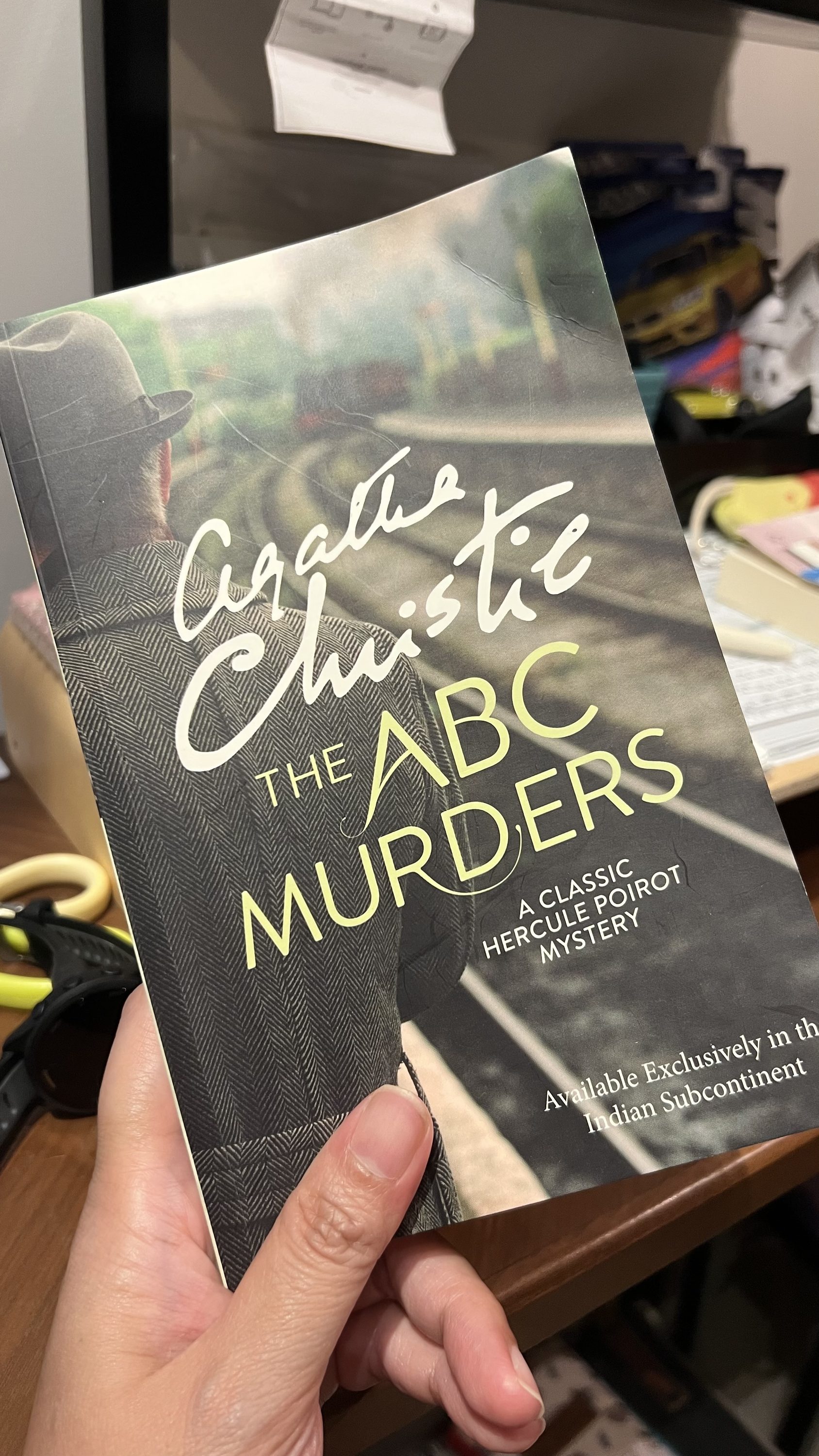
Next read: “The ABC Murders” by Agatha Christie. I vowed to finish all Agatha Christie books that I have right now ASAP. I still have some more books of Maurice Leblanc’s “Arsene Lupin”, too. I mean, my To Read list has been, uh, long.